
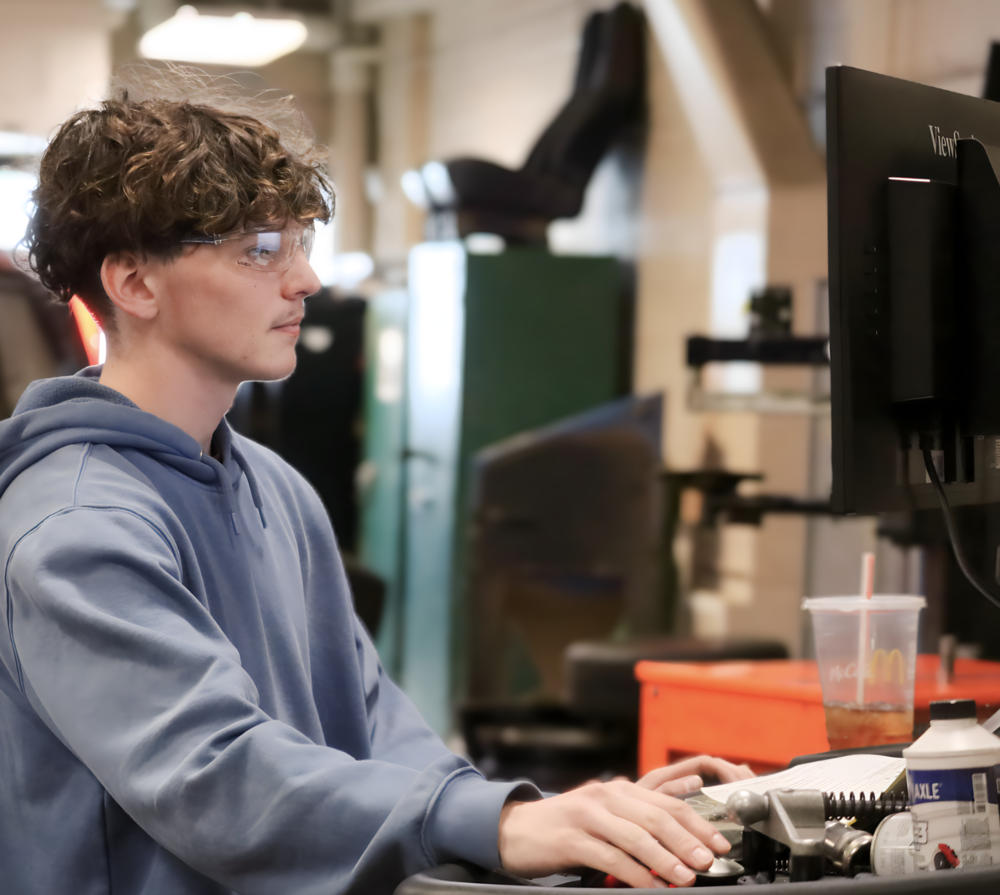
For second-year Auto Technology student Lucas Morrison, a LeRoy Central School student attending the Batavia CTE Center, choosing the AutoTech program was a natural next step in a passion that began years ago. “I’ve always really liked cars,” he said. That interest only grew when he purchased a fixer-upper—a 1971 MG. Working on the classic car in his driveway sparked a curiosity to understand not only how cars run but how to repair and restore them. “When I took this class, everything I was learning here kind of connected with what I was doing on my own,” he explained. “It all started to make sense.”
One of the biggest reasons Lucas chose the program was the chance to get out of a traditional classroom and into a real shop environment. The hands-on learning style makes a meaningful difference. “Hands-on is the best way for me to learn,” he said. “Half the day I’m in school, and the other half I’m out here actually doing the work. It’s a completely different atmosphere. I think a lot of kids here feel that way—everyone learns differently, and this works for us.”
The program prepares students for real-world automotive careers, starting with the foundational skills expected at a dealership. “You’d probably start as a lube tech,” Lucas said, describing a common entry-level position. “You do oil changes, tire rotations, change tires, and do alignments. That’s exactly what we do here. There’s always an alignment or an oil change or something like that in the shop.” While routine maintenance is part of their daily work, students also get opportunities to take on bigger jobs when they come in. First-year students focus on steering and suspension, while second-years move into electrical systems, giving them a broad range of knowledge before graduation.
Lucas has big plans for life after high school, and he is exploring multiple college options. He has visited Alfred State, ECC, MCC, Ohio Technical College, and the University of Northwestern Ohio—each offering different paths within the automotive world. “I know I want to do something automotive,” he said. “You can start at a dealership and work your way up, but I think I’d rather go to school and start a little higher. That feels more beneficial to me.” During one college visit, he learned about high-performance automotive programs focused on racing and engine building, which immediately caught his attention. “It’s really cool. They’re building engines and making a lot of power,” he said. “If I had the opportunity to work in something like racing or even a pit crew, I’d definitely try it. The atmosphere is insane.”
Among the many projects Lucas has worked on, one in particular stands out—a Jeep that came into the shop last year with a blown head gasket. “We started it up one time and it smoked so bad it filled the whole shop,” he said, laughing at the memory. The dramatic moment quickly turned into a valuable learning experience, and Lucas hopes the class will have time to rebuild it this year. “It’d be a really cool job to take on,” he said. “Taking the head off, seeing the damage, fixing it—it’s real work.”
Lucas knows that not every student who takes the program will pursue automotive as a career, but he believes the skills they learn are valuable for everyone. “If you think you’re interested, try it,” he said. “Even if it’s not your career, you can learn to do your own brakes, change your oil—good skills to have no matter what. It all adds up.” What stands out to him most is how many opportunities exist in the automotive field. Students can go into dealerships, specialize in performance engines, work in body shops, or explore racing. “There’s a lot of money in the trades, and a lot of different options,” he said. “I enjoy it, and there are so many ways you can go. That’s the really cool thing about this program—you’re not stuck in one direction. There’s a whole world you can explore.”