
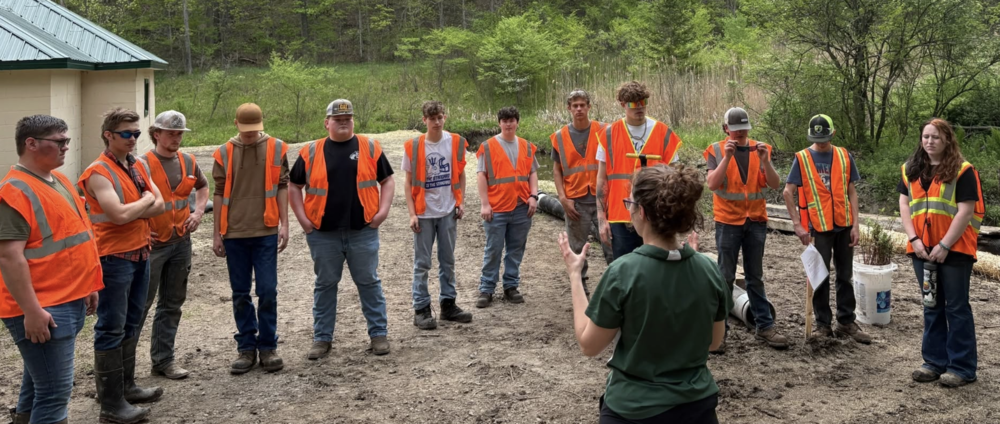
Students from the Conservation program at the Batavia Career and Technical Education Center spent the school year working to help reduce erosion and restore habitat along Black Creek through the Healthy Headwaters: Black Creek Restoration Project. Through hands-on fieldwork and a week-long internship experience, students gained valuable conservation and workforce skills while helping improve the health of the local watershed.
Under the guidance of Conservation teacher Jerry Krajna, students worked alongside Genesee County Parks & Forest, including Conservation Education Program Coordinator Claudia Nusslein, and the Genesee County Soil & Water Conservation District throughout the year as part of a grant-funded initiative focused on improving the health of Black Creek at the Genesee County Park & Forest in East Bethany. Funding for the Healthy Headwaters project was provided by the NYS Environmental Protection Fund through the New York Sea Grant Great Lakes Small Grants Program, administered in partnership with the New York State Department of Environmental Conservation Great Lakes Program under a prime agreement with Cornell University.
The project focused on restoring a riparian habitat area along the creek that had experienced severe erosion. Black Creek begins its journey to the Genesee River within the park, making the site an important area for watershed protection and wildlife habitat restoration. Students learned about erosion control, shoreline stabilization, habitat management, and environmental stewardship while actively participating in the restoration process.
Throughout the year, Conservation students visited the site as a class to study the creek, monitor conditions, and assist with restoration planning and preparation. Students learned about the environmental impact of erosion and the importance of healthy streambanks in protecting water quality and aquatic habitats while gaining experience working outdoors in all types of conditions.
The project culminated with a week-long internship experience for a smaller group of selected students who worked on-site daily alongside environmental professionals and community partners. Conservation students and Diesel Technology students were selected for the experience, with the Diesel students assisting with equipment inspections, machinery support, and labor throughout the restoration process. Students interested in participating were required to apply for the internship by developing resumes and cover letters and completing mock interviews to prepare for the experience.
Students selected for the internship included Ethan Bastedo, Cylie Finkey, Aiden Kopper, Liam Lamb, Jayden Harkins, Thomas McGinnis, Parker Shepard, Hunter Wagner, Jacob Gray, and Tyler DeLand. During the week, students helped remove failed gabion baskets, stabilize sections of the shoreline, and plant native shrubs whose root systems will help prevent future erosion and strengthen the creek bank for years to come. Students later returned to the site as a class to help complete the final stages of the project and continue planting efforts. By the end of the restoration work, more than 300 native shrubs had been planted throughout the project site.
Throughout the project, students worked side-by-side to complete the restoration work, digging holes along the creek bank, planting native shrubs together, and rolling out straw to help stabilize the shoreline and prevent further erosion. Students spent hours working directly in and around the stream, learning firsthand what it takes to restore and protect a natural habitat. Along the way, they also experienced the wildlife that depends on the creek ecosystem, spotting minnows, frogs, worms, a water snake, and even a hawk while working at the site.
During one of the project workdays, Claudia Nusslein praised the students’ efforts, telling them, “This looks amazing. The work crew came through last week and absolutely knocked it out of the park.” The experience gave students an opportunity to work together outside of the classroom in an environment where teamwork, communication, and trust were essential each day.
Conservation student Cylie Finkey, a senior from Pembroke Central Schools, said she chose the program because of her passion for wildlife and the outdoors and saw the project as an opportunity to gain experience with heavy equipment while exploring future career paths. She said the internship gave students the chance to experience what working on an actual job site is like. “We had our PPE on, our helmets and vests, and got right to work,” Cylie said. “It felt like a real job site.”
Conservation senior Aiden Kopper of Batavia City Schools said one of the most rewarding parts of the project was seeing how much the site changed over time and knowing students played a role in fixing the erosion issues along the creek. “It’s crazy how it looks now compared to the beginning,” Aiden said. “It feels good being able to come out here and see that I helped do this.”
Two students from the Diesel Technology program also participated in the internship experience, helping inspect and maintain equipment used throughout the project while assisting students on-site with labor and restoration work. Their involvement demonstrated how multiple career and technical education programs can collaborate on real community projects. Cylie said the Diesel students “checked all the equipment and made sure everything was running good” and “helped us a lot and did way more than they needed to.”
The Healthy Headwaters project connected students with professionals from a variety of environmental and conservation careers while allowing them to apply classroom knowledge in a real-world setting. Students gained experience using hand tools and heavy equipment while learning about stream restoration, habitat protection, and natural resource management.
The Healthy Headwaters project was funded through the New York Sea Grant Great Lakes Small Grants Program, administered in partnership with the New York State Department of Environmental Conservation under a prime agreement with Cornell University.
By the final day of the project, students had not only helped restore an important section of Black Creek, but had also gained valuable workforce experience, professional connections, and a deeper understanding of how conservation work can positively impact local ecosystems and communities.